
LED (Light Emitting Diode)
LEDs are energy‑efficient semiconductors that emit light when electric current passes through a p‑n junction. They are used in indicators, displays, and lighting because they consume low power, last long, and switch quickly.
Key Details:
An LED has two terminals: an anode (positive, longer leg) and a cathode (negative, shorter leg). It requires a current-limiting resistor to prevent it from burning out. The color of the light depends on the semiconductor material used.
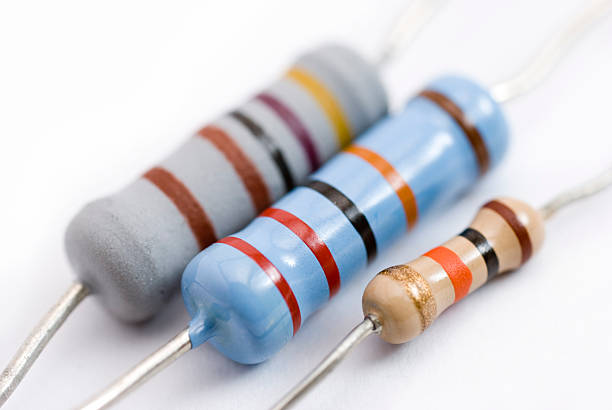
Resistor
A resistor is a passive electrical component with a specific electrical resistance. Resistors are used to reduce current flow, adjust signal levels, divide voltages, and terminate transmission lines, among other uses.
Key Details:
The value of a resistor is indicated by colored bands on its body. Each color represents a number, a multiplier, and a tolerance. They are non-polarized, meaning they can be connected in any direction in a circuit.

Transistor
A transistor is a semiconductor device used to amplify or switch electronic signals and electrical power. It is the fundamental building block of modern electronic devices, from radios to computers.
Key Details:
The most common type is the Bipolar Junction Transistor (BJT), which has three terminals: the base, collector, and emitter. A small current at the base can control a much larger current between the collector and emitter, allowing it to act as a switch or amplifier.
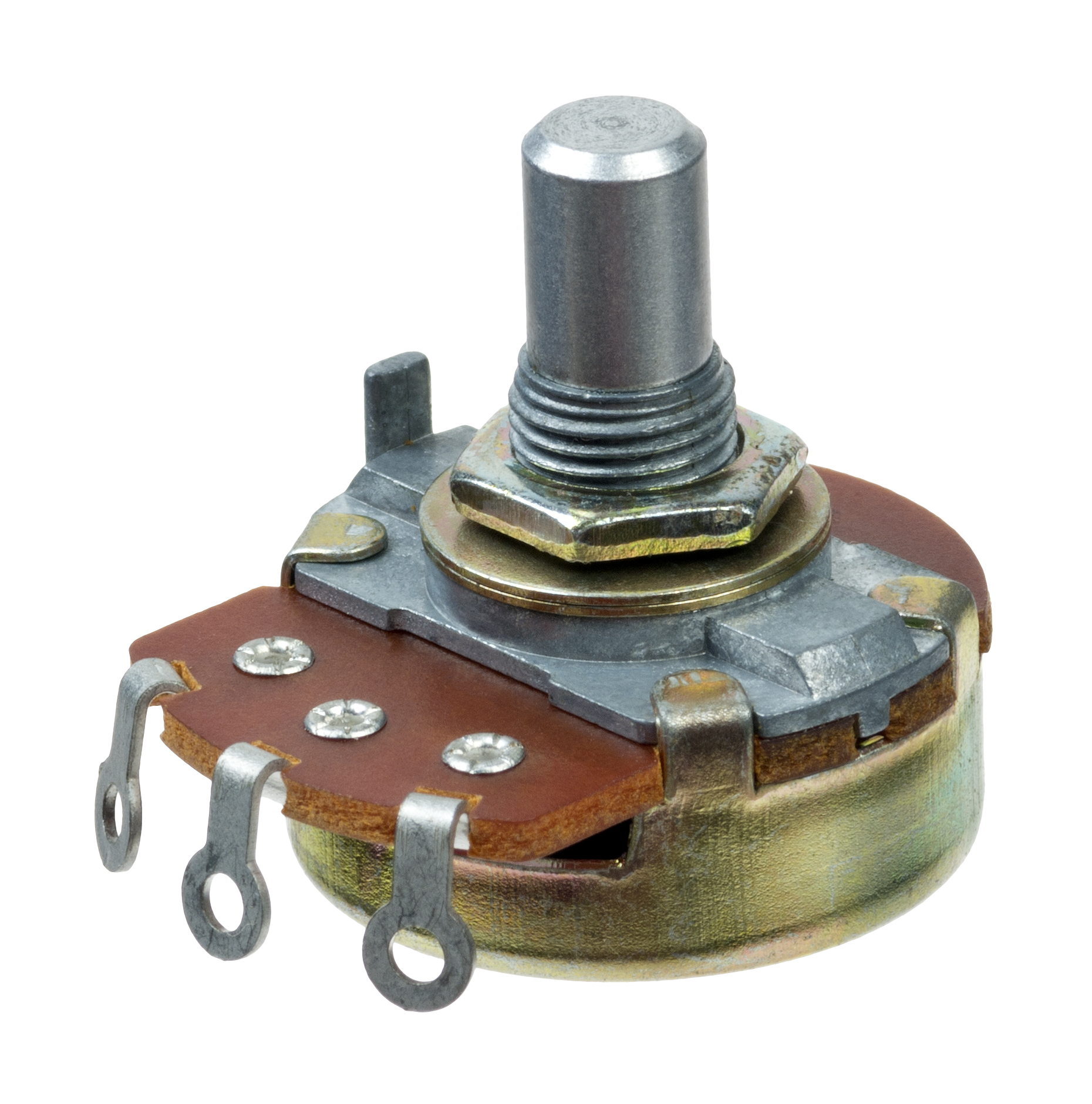
Potentiometer
A potentiometer is a three-terminal resistor with a sliding or rotating contact that forms an adjustable voltage divider. It is commonly used as a volume control in audio equipment or as a position sensor.
Key Details:
It has three terminals. The outer two are connected to a resistive track, and the middle terminal (the wiper) moves along this track. By reading the voltage at the wiper, you can determine its position, making it a useful analog input for microcontrollers.
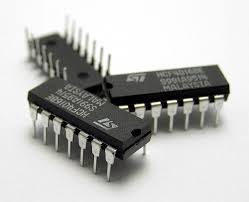
Integrated Circuit (IC)
An Integrated Circuit (or IC) is a set of electronic circuits on one small flat piece (or "chip") of semiconductor material. ICs are the brains of most electronic devices, containing millions or billions of transistors.
Key Details:
ICs come in various packages, like the Dual In-line Package (DIP) shown. They can be general-purpose (like the 555 timer) or highly specialized (like a CPU). A notch or dot on the package indicates the location of pin 1 for correct orientation.

DC Motor
A simple output device that converts electrical energy into continuous rotational motion. They are widely used in toys, drones, and robotic applications due to their simplicity and ease of control.
Key Details:
A simple DC motor has two terminals. Applying a DC voltage causes the shaft to spin. Reversing the polarity of the voltage will reverse the direction of rotation. The speed can be controlled by varying the voltage, often using a technique called Pulse Width Modulation (PWM).

Servo Motor
A motor designed for precise positional control. Unlike a DC motor that spins continuously, a servo can be told to move to a specific angle and hold that position.
Key Details:
Servos typically have three wires: power (VCC), ground (GND), and a signal wire. The position is controlled by sending a specific type of pulse (PWM) on the signal wire. They are essential for robotics, RC cars, and any application needing controlled movement.

Capacitor
A passive two-terminal component used to store electrical energy in an electric field. They are used for filtering, timing, energy storage, and smoothing power supplies.
Key Details:
It consists of two electrical conductors separated by a dielectric (insulating) material. Capacitance is measured in Farads (F). They can be polarized (electrolytic) or non-polarized (ceramic, film).

Inductor
A passive two-terminal electrical component that stores energy in a magnetic field when electric current flows through it. Inductors resist changes in current flow.
Key Details:
Typically consists of a coil of wire. Inductance is measured in Henries (H). They are used in filters, tuning circuits, and for energy storage in switching power supplies.

Diode
A two-terminal semiconductor component that allows electric current to flow effectively in one direction while blocking it in the opposite direction.
Key Details:
Diodes have an anode (positive) and a cathode (negative). They are used for rectification (converting AC to DC), voltage regulation (Zener diodes), and signal demodulation. LEDs are a specific type of diode.

Switch
An electrical component that can make or break an electrical circuit, interrupting or diverting the electric current.
Key Details:
Switches come in many forms (toggle, push-button, slide, rocker) and configurations (SPST, SPDT, DPST, DPDT) depending on the number of poles (circuits controlled) and throws (positions). They are fundamental for controlling power and signals.

Battery
A device that converts stored chemical energy into electrical energy, providing a portable source of power.
Key Details:
Batteries consist of one or more electrochemical cells with an anode, cathode, and electrolyte. They are characterized by their voltage, capacity (mAh), and chemistry (e.g., Alkaline, Li-ion, NiMH). Used to power countless electronic devices.

Connector
An electromechanical device used to join electrical conductors and create an electrical circuit, facilitating connection and disconnection without soldering.
Key Details:
Connectors come in various types (e.g., USB, JST, header pins, barrel jacks) and are crucial for modularity and interfacing different parts of an electronic system. They ensure reliable electrical contact.

Relay
An electrically operated switch that uses an electromagnet to mechanically operate a switch, controlling a high-power circuit with a low-power signal.
Key Details:
Relays provide electrical isolation between the control circuit and the switched circuit. They are commonly used to switch AC or high-current DC loads, protect circuits, and implement logic functions.

Oscillator
An electronic circuit that produces a repetitive, oscillating electronic signal, often a sine wave or a square wave.
Key Details:
Oscillators are essential for generating clock signals in microcontrollers, radio frequency signals in communication systems, and timing signals in various electronic applications. They can be based on RC, LC, or crystal components.

Arduino
An open-source microcontroller board (like the Uno) designed for easy physical computing. Its purpose is to read inputs (sensors) and control outputs (motors, LEDs) by executing a single, repeating program ("sketch") for real-time electronic control.
Key Details:
Arduino boards are programmed using the Arduino IDE with a simplified C++ language. A program, called a "sketch," is uploaded to the board and runs in a loop, making it ideal for interacting with the physical world through sensors and actuators.

Buzzer
An output device that converts an electrical signal into an audible tone or sound. They are commonly used for alarms, notifications, or simple sound effects in electronic projects.
Key Details:
Buzzers can be passive or active. Active buzzers produce a tone when power is applied, while passive buzzers require a varying electrical signal (like a PWM signal from a microcontroller) to produce different pitches and melodies. They are typically low-power devices.

Sensors
An input device that detects and measures a physical property from the environment and converts it into a measurable electrical signal (voltage or digital data) for a microcontroller to process.
Key Details:
Sensors are the "senses" of an electronic project. They come in many types, such as temperature sensors (like the LM35), distance sensors (ultrasonic), light sensors (LDRs), and motion sensors (PIR). They can provide analog (a range of voltages) or digital (on/off or data) outputs for a microcontroller to read and act upon.

Breadboard
A solderless construction base used for prototyping electronic circuits. It allows you to build and test circuits quickly without permanent connections.
Key Details:
A breadboard has rows of interconnected holes. The outer two columns on each side (power rails) are connected vertically, while the inner holes are connected horizontally in short rows. This makes it easy to connect components with jumper wires.

Jumper Wires
Insulated electrical wires with connector pins at the ends. Used to interconnect components on a breadboard or to a microcontroller's pins.
Key Details:
Jumper wires come in three main types: male-to-male (pins on both ends), female-to-female (sockets on both ends), and male-to-female. They are essential for creating flexible and temporary connections in prototypes.